
Display
How non-SDF and hidden Blender objects render alongside the SDF scene, plus the proxy-mesh bake that makes Chisel objects work in EEVEE / Cycles / Solid view.
For the in-viewport gizmo toggles (axis arcs, click-drag dots), see Gizmos.
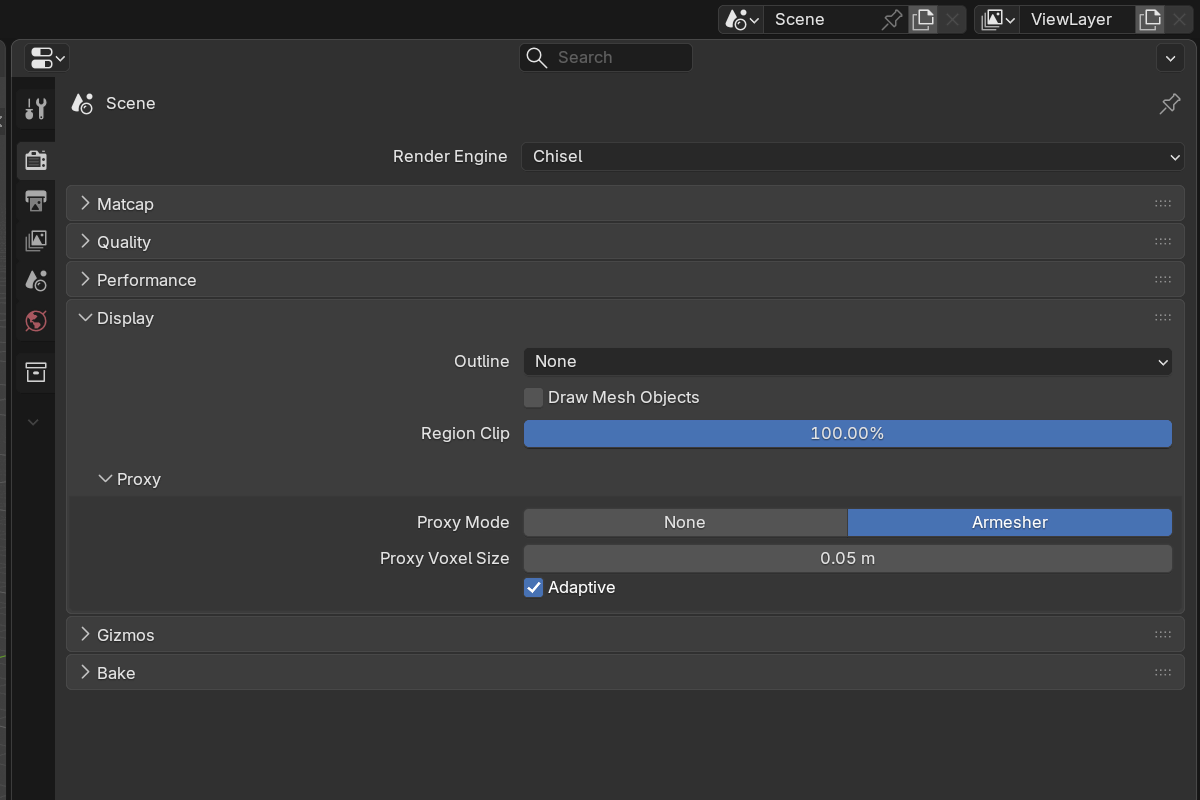
Parameters
These are scene-level defaults applied to new boolean targets and cutters as they’re created — they don’t retroactively change objects already in the scene.
- Outline —
None / Wire / Bounds, default None. The display type given to new targets/cutters:- None — leave the display type unchanged.
- Wire — show new targets as wire outlines.
- Bounds — show new targets as bounding boxes (shape-matched to the primitive type).
- Show Bounds — default off. When on, new boolean targets/cutters get Blender’s native bounding-box display so non-rendered helpers stay visible as a box.
- Draw Mesh Objects — default off. Render regular Blender meshes alongside the SDF, shaded with the same matcap.
- Region Clip —
10–100%, default100%. Render only a centered fraction of the viewport to reduce GPU load.
Render flag vs. viewport display
Each Chisel object has a Render toggle (render_sdf, default on) in the Object Properties → SDF panel. It decides only whether the SDF engine renders that object — it’s fully decoupled from how the object looks in the viewport. Helper objects, boolean operands, and reference geometry typically have Render off.
Because render visibility and viewport display are independent, you can hide a shape from the render without hiding it in the viewport: turn Render off and the object still shows as its proxy mesh, wire, or bounds. Flipping Render back on renders it again regardless of its display type. The Outline and Show Bounds defaults above just set how freshly created cutters first appear.
Draw Mesh Objects
When Draw Mesh Objects is on, regular Blender mesh objects (those not converted to Chisel) render alongside the SDF using the same matcap shading. Useful when:
- Building a scene that combines SDF carving with regular polygonal props
- Importing reference geometry for layout or scale
When off, regular meshes don’t render — only Chisel objects do.
Proxy mesh
Chisel can bake a low-resolution mesh proxy from each SDF object so it renders correctly in EEVEE, Cycles, and Solid shading — and so snapping, selection, and raycasting work on the SDF surface.
Parameters
- Proxy Mode
- None — no proxy. The base mesh stays as-is.
- armesher — bake a low-res proxy on each settle. Accurate; only runs once you stop moving so it doesn’t slow you down.
- Voxel Size —
0.001–10.0scene units, default0.05. Voxel edge length for the proxy bake.- When Adaptive is off, this is the world-space voxel size for every object.
- When Adaptive is on, this is the voxel size for a 2 m reference object — smaller objects get proportionally smaller voxels, larger objects get larger voxels.
- Voxel Adaptive — default on. Scales voxel size with object dimensions so every Chisel object ends up with roughly the same cell count.
When to use proxy mode
| Need | Proxy Mode |
|---|---|
| Pure Chisel renders, no EEVEE/Cycles needed | None |
| Snap / raycast / select on SDF surfaces | armesher |
| EEVEE / Cycles renders alongside Chisel | armesher |
| Solid shading mode shows the correct silhouette | armesher |
Voxel-size guidance
- Default
0.05with adaptive on works for most scenes. - Tighter
0.01–0.02for fine details (engraved text, sharp seams). - Coarser
0.1–0.2for large architectural shapes where the proxy doesn’t need to resolve detail. - Adaptive off if your scene mixes very different object sizes and you want a uniform voxel size scene-wide.
If you ever see a version mismatch warning on the proxy library, click Update Native Libraries in Preferences and restart Blender.
See also
- Gizmos — viewport gizmo overlay toggles
- Matcap — viewport shading
- Performance — adaptive quality during navigation
- Operations: Convert — full mesh conversion (separate from the proxy)
- Operations: Veil — quickly hide every non-rendered object